A strategic game is a great way to train the brain.
And if you’re a fan of strategic board games for two players like chess, you’re likely to enjoy the game of Go. Invented in the Chinese royal court thousands of years ago, this “brain” game with a long and rich history is considered one of the oldest board games in the world.
Go quickly became an important part of Chinese culture, and its popularity later spread to other countries in East Asia. Today, Go remains one of the World’s most popular strategic board games for people who love to challenge their brains and intuition.
What is Go?
Go is a competitive game for two players where the aim is to claim territory by occupying and surrounding more empty spaces on the board with one’s stones than the other player.
One plays with black stones and the other with white stones. The concept of surrounding stones is central to the game.
The Origins of Go
The game of Go, also known as Weiqi in Chinese, is believed to have been invented in China more than 2,500 years ago. Although the exact origins of the game are not clear, according to legend, it was created by the Chinese emperor Yao as a way to teach his son discipline and strategic thinking.
Over time, the game became popular among the ruling class and eventually spread throughout China and beyond.
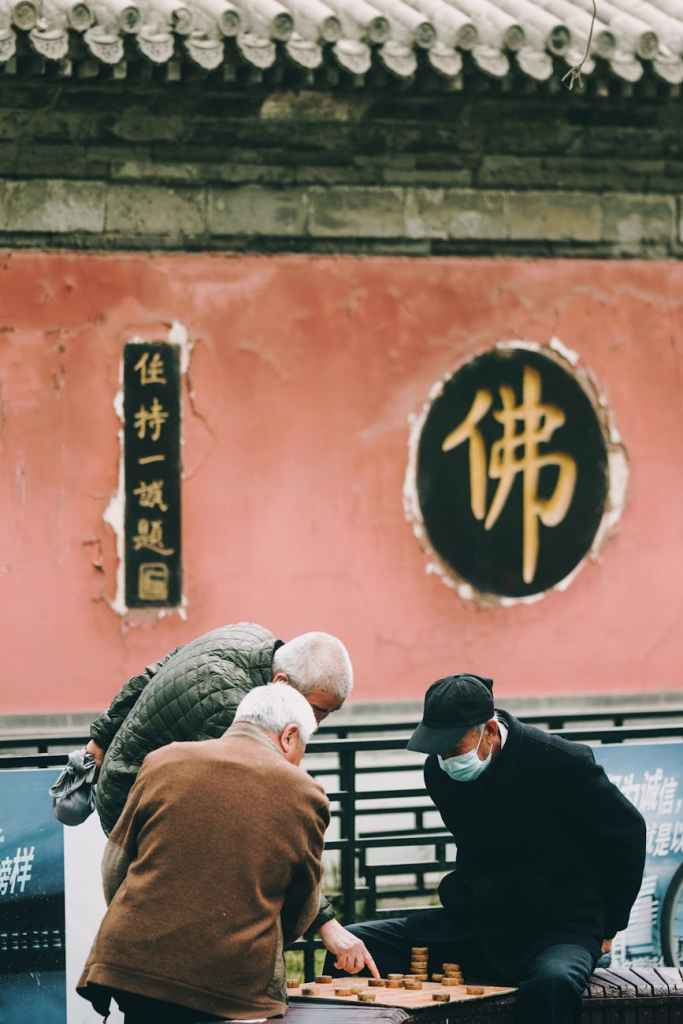
Go in Ancient China
At the time, Go was considered an important intellectual pursuit and was often used as a way to train the mind and improve cognitive abilities. During the Tang Dynasty (618-907 AD), the game became a symbol of Chinese culture and intelligence. Since the Tang Dynasty was also a time of great cultural prosperity in China, many famous scholars and poets were known to have been keen players of the game.
It was also used as a way to build relationships and socially connect with others. It’s common to see people playing Go in tea houses and other social gatherings.
Go vs Chess
Go and chess are both classic strategy games that are widely popular today. At this point you may wonder what are the key differences between the two.
- Origins:
- Go was invented in China over 2,500 years ago
- Chess was born out of the Indian game Chaturanga around 1,500 years ago.
- Board size and layout:
- Go is played on a 19×19 grid (or sometimes smaller grids) with intersections as the playing points. Both players use uniform stones, and all stones have the same value and ability.
- Chess is played on an 8×8 square board with alternating black and white squares. Both players use different pieces (king, queen, rook, knight, bishop, and pawn), each with unique movement and strategic roles.
- Objective:
- The goal of Go is to control the most territory by surrounding empty spaces on the board with your stones.
- The goal of chess is to checkmate the opponent’s king, placing it under direct threat of capture with no possible escape.
- Complexity:
- Go is often considered more complex than chess because the number of possible game states is much higher. On a standard 19×19 Go board, there are more possible board configurations than there are atoms in the observable universe.
- Chess is considered more complicated in terms of tactical and precise calculations. Chess has well-documented opening theories and endgame strategies that players must study to reach high levels of skill.
Difference in Go Styles
Go was introduced to Korea around the 5th century and was popular among the ruling classes. In Korea, the game is called Baduk. By the 7th century, the game reached Japan where it is called Go or Igo. There were many Go schools founded in Japan where every year during the Edo period top players came to compete in the annual games at the shogun’s castles.
Go Game for Intelligence and Intuition
In the past, Go was considered one of the four arts of the Chinese scholars and noblemen, along with calligraphy, painting and playing Guqin (the Chinese musical instrument). Today, Go is popular among people of all ages and backgrounds as it is viewed as a strategic and intellectually stimulating game. But how exactly can Go benefit our brain?

- Simple rules, infinite possibilities
We already know that Go has incredibly simple rules with two players alternately placing black and white stones on the grid with the objective of surrounding territory and capturing the opponent’s stones.
That’s easy to learn, right? However, with an enormous number of potential moves at any point in the game, there is no fixed or optimal path. This requires the brain’s deep thinking, creativity, and flexibility since there is no perfect solution or single correct strategy.
- Long-term planning and adaptation
Unlike many other strategic games, Go requires long-term strategy. Players must think ahead and consider how current moves will affect future board states. This helps develop the brain’s ability to think many moves ahead and predict the outcome of various possibilities.
The ability to adjust tactics in response to unforeseen events requires intellectual agility.
- Deep abstract thinking
Understanding how to control space and predict potential territories without direct control challenges the player’s spatial awareness and abstract reasoning
- Pattern recognition and memory
Players often rely on intuition and experience to recognise patterns of stone arrangements, known as “shapes”. Recognising which shapes are strong, weak, or efficient is essential for making quick judgements during the game.
The process of memorisation helps to strengthen memory and cognitive skills. Over time, the intuitive understanding of different patterns allow them to recall the information with ease and speed.
- Concentration and focus
Due to the high level of mental effort, Go players must remain focused on the board at all times in order to analyse the position of stones and anticipate their opponent’s moves. A single moment of distraction can result in a major disadvantage or loss of points.
- Mind and Intuition
However, since Go games can last for hours, some players actually see the game as a way to develop mindfulness. It’s the beauty of staying present and fully engaged in the current moment. Others see it as a pastime that helps reduce stress and improve mood.

So…
If you’ve heard of AlphaGo, a computer programme developed by Google that combines Deep Learning with advanced search algorithms to play Go, you may also know that it made headlines in 2016 by defeating the world champion Lee Sedol, leaving millions of viewers in awe.
This has raised many big questions worldwide on AI advancing beyond human intuition, creativity, decision-making, as well as AI’s future potential and threats. I’m not going to touch those areas in this issue but it’s up to you to decide.
Play is the brain’s favourite way of learning. – Diane Ackerman
For now, Go is to me an ancient Chinese game of wisdom that is great for mindfulness and cognitive training. When long-term strategy
wins over speed, you know Go is certainly not a game of chance but the understanding of life and death in each move – and how to handle it with grace.
All rights reserved. Used by Permission of DeepGamma.
 DeepGamma.
Leave a comment