Yin-Yang represents two opposite forces that exist in harmony.
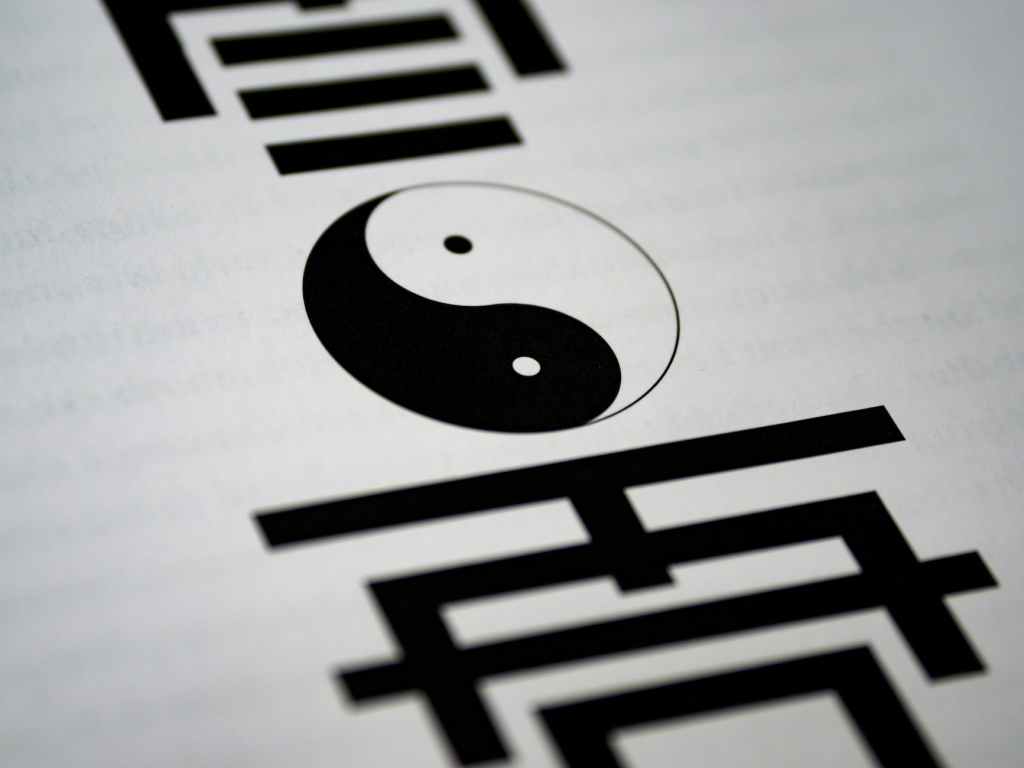
You may instantly recognise the popular symbol of Yin-Yang that is used in almost anything from a religious sigil, fashion icon to a tattoo design: a circular diagram composed of two teardrop-shaped halves, one black and one white. The black half has a white dot in its centre, and the white half has a black dot in its centre. However, how much do you know of the real meaning behind it, including its significance to a balance of your mind, body, and soul?
What is Yin-Yang?
Yin-Yang is one of the best-known fundamental concepts in ancient Chinese philosophy. It represents the duality of nature and the balance of inseparable, complementary, and opposing forces that exist in the universe.
The concept of Yin-Yang originated in China. However, it’s not attributed to any one individual inventor, but rather emerged from the collective wisdom of Chinese culture over many centuries.
The earliest known reference to the Yin-Yang concept comes from the I Ching or Book of Changes, which is an ancient Chinese divination text dating back to the Western Zhou period (1046 – 771 BCE.) The I Ching describes Yin-Yang as complementary opposites that interact to form a unified whole.
Yin represents the feminine, receptive and passive aspects of existence. On the other hand, Yang represents the masculine, active and assertive aspects.
They are often depicted as two halves of a circle, with Yin occupying the dark portion while Yang occupying the light portion.
According to Chinese philosophy, everything in the universe is composed of these two complementary forces, and they must be in balance for harmony and well-being to exist. When Yin and Yang are in balance, there is harmony and peace, but when one dominates the other, there is chaos and conflict.
Yin-Yang: The Mythology
The concept of Yin and Yang is believed to originate in ancient Chinese mythology and cosmology. According to this mythology, the universe began as a primordial chaos or void, known as Wuji. From this void emerged two complementary forces, Yin and Yang, which became the fundamental principles of the universe.
In Chinese mythology, Yin and Yang are often personified as deities. Yin is associated with the moon, darkness, cold, water, and death. It is normally represented by a tiger or a dragon.
Yang is associated with the sun, light, warmth, fire, and life. It is normally represented by a phoenix or a dragon. The mythology of Yin and Yang is deeply intertwined with Chinese philosophy, particularly Taoism and Confucianism. Apart from achieving harmony and happiness in life, the philosophy also stresses the importance of accepting change and the natural cycles of life. These are undoubtedly reflected in the constant interplay between Yin and Yang.
Yin-Yang: in Modern Times
While the origin of the concept cannot be attributed to any one individual, it’s believed that the Taoist philosophers Lao Tzu and Chuang Tzu contributed to the development and popularisation of the Yin-Yang concept.
Over time, the concept of Yin and Yang became more widely accepted and integrated into various aspects of Chinese culture, including traditional Chinese medicine, art, martial arts, psychology, politics and even business management. Nowadays, the concept is central to traditional Chinese medicine and is used to explain the interplay between different body systems and functions. When your physical or mental health are out of balance, you may want to first check your Yin and Yang and adopt a wholistic approach for treatment rather than looking at it as an individual problem.

Yin-Yang that Shapes the Universe
Yin and Yang can be seen in many aspects of life. Generally speaking, Yin is associated with passivity, rest, and stillness, while Yang is associated with activity, action, and movement. Here are some examples of Yin and Yang forces that shape the universe and everything in it.
- Light and Dark
Light represents Yang, while darkness represents Yin. The sun is considered a Yang force, while the moon is considered a Yin force.
- Heaven and Earth
Heaven represents Yang, while Earth represents Yin. The sky and the stars are considered Yang forces, while the land and the mountains are considered Yin forces.
- Hot and Cold
Heat represents Yang, while cold represents Yin. The sun’s warmth is Yang force, while snow and ice are Yin forces.
- Male and Female
Masculinity represents Yang, while femininity represents Yin. Men are considered a Yang force, while women are considered a Yin force.
- Active and Passive
Action represents Yang, while passivity represents Yin. Doing represents Yang, while being represents Yin.
These are just a few examples as the concept of Yin and Yang is complex and can be applied to a wide range of phenomena, including natural elements, human characteristics, and social dynamics, among others.

Yin-Yang in Different Aspects of Life
In a business seminar and workshop early this year, I met a doctor of traditional Chinese medicine who had spent six years completing her degree in Shanghai, China, before going back to her hometown to open a medical practice in Chiang Mai, Thailand. We talked through many aspects of business, modern life, and health.
Growing up in a half Chinese family, I’m already well aware of the importance of keeping Yin-Yang energies balanced in order to maintain and support a good state of physical and mental well-being. However, the encounter with her has heightened my awareness to the next level.
In Chinese philosophy, it’s believed that everything in the universe is in constant motion, and that this motion is driven by the interplay between Yin and Yang forces. For example, when Yang forces are dominant, there’s movement, growth and expansion. On the other hand, when Yin forces are dominant, there’s stillness, rest and contraction.
In Chinese medicine, the concept of Yin-Yang is used as a holistic approach to diagnose and treat illnesses. As mentioned earlier, everything in the universe has opposite forces and it also holds true for the human body. When a person is with too much Yang energy, they may experience symptoms such as restlessness, hyperactivity, tension, inflammation and high blood pressure. On the other hand, too much Yin energy in the body can cause symptoms such as fatigue, cold hands and feet, stiffness, pale complexion and low blood pressure.
In relationships, the active force is the action of giving, while the passive force is the action of receiving. A health relationship requires a balance of give and take, independence and interdependence, as well as ups and downs moments. This will help the couple go through difficult times together and enjoy the happy times even more.
In studying, the principles of Yin-Yang can also be applied in a number of ways such as balancing study and rest. Yang forces represent the active and focused state of mind required to learn new things. Yin forces, however, represent the passive and restful state of mind to absorb information, retain what has been learned, and avoid burnouts. This also includes balancing the use of active learning techniques and taking necessary breaks.The list goes on. Yin-Yang forces are present in all areas of life. How are we going to balance them and live in alignment with the natural course of the universe?
Yin-Yang vs Wu Wei
You may still remember the concept of “Wu Wei”, an ancient philosophical teaching from Taoism, I mentioned in the previous post. Wu Wei is the art of effortless living in harmony with the nature. Yin-Yang and Wu Wei are two concepts that are closely related in Chinese philosophy.
While Yin-Yang represents the duality and interdependence of opposite forces in the natural world, Wu Wei represents the art of effortless action and non-doing. The balance is achieved by letting go of the desire to control and manipulate the world around us.
Interestingly, both Yin-Yang and Wu Wei concepts emphasise the importance of mindfulness, balance, and flow in daily lives. Just as Yin-Yang seek balance and harmony between opposing forces, Wu Wei suggests that we should align our thoughts and actions with the natural rhythm of the universe, finding the path of least resistance.
So..
Overall, the concept of Yin-Yang reminds us that they are two sides of the same coin. Life is about interdependence of opposing forces and change is inevitable. We all have a mind, a body, and a soul, which make up the entirety of our being. We cannot over focus on one or two things while disregarding the other.
Once we understand and embrace this perspective, we can examine our own strengths, weaknesses, and identify areas in life where there may be a disharmony. The self-awareness will guide us in making better adjustments, adaptability and cultivating personal growth in areas where it is needed. When living in alignment with Yin-Yang and getting back to the balancing flow of the universe, we find a more harmonious and fulfilling existence.
All rights reserved. Used by Permission of DeepGamma.
 DeepGamma.
Leave a comment